




A few years ago, building a personal brand meant hiring a designer, a copywriter, and maybe a video editor — or doing all three yourself at 1 a.m. with three cups of coffee. That barrier is gone. In 2026, one person with the right AI stack can produce content that looks like it came from a small agency.
- Why a Personal Brand Matters More Than Ever in 2026
- What AI Can (and Can’t) Do for Your Brand
- How to Build a Personal Brand Using AI Tools: A Step-by-Step System
- The Best AI Tools to Build Your Personal Brand in 2026
- Common Mistakes That Quietly Kill AI-Built Brands
- A Realistic 30-Day Starting Plan
- Frequently Asked Questions
- Is it too late to build a personal brand with AI tools in 2026?
- Do I need to pay for AI tools to get started?
- Will AI-generated content hurt my credibility?
- How much time does this actually take each week?
- Which platform should I focus on first?
- How do I keep my brand sounding like me and not like a robot?
- Your Move
I’ve spent the last several months testing tools, posting consistently, and watching what actually moves the needle. What I found surprised me: the hard part was never the tools. The hard part is knowing what to say, how often to show up, and how to sound like a real human while still using AI to do the heavy lifting.
So if you want to build a personal brand with AI tools in 2026 without burning out, this guide is the exact system I’d hand to a friend starting from zero today.
Why a Personal Brand Matters More Than Ever in 2026
Your online presence has quietly become your real résumé. When someone hears your name, they search it — and whatever shows up first becomes their first impression of you.
A strong personal brand does a few things at once. It builds trust before you ever speak to someone. It opens doors to clients, jobs, partnerships, and speaking opportunities. And it compounds: every post you publish keeps working for you long after you hit “share.”
Professional credibility online isn’t just a vanity metric, either. Profiles with polished, consistent presentation get noticeably more views, messages, and opportunities than neglected ones, according to data shared by LinkedIn. The takeaway is simple — showing up well is no longer optional.
The good news? You no longer need a big budget or a design degree to compete. AI has leveled the field for solo creators, freelancers, and small business owners.
What AI Can (and Can’t) Do for Your Brand
Before we get into tools, let’s set expectations, because this is where most people go wrong.
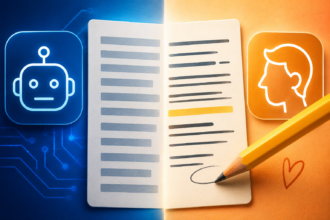
AI is excellent at speed, structure, and starting points. It can draft, repurpose, design, and organize faster than any human. What it can’t do is decide who you are, what you believe, or what story only you can tell.
Think of AI as your team, not your replacement. You’re still the founder, the editor, and the voice. The AI just removes the friction between your ideas and the published result.
Keep that framing in mind and you’ll avoid the most common trap of 2026: generic, soulless content that sounds like everyone else. The creators winning right now use AI to amplify a real personality — not to manufacture a fake one.
How to Build a Personal Brand Using AI Tools: A Step-by-Step System
Here’s the practical part. Follow these steps in order. You can complete the foundation in a single focused weekend.
Step 1: Define Your Brand Positioning
Open any AI chat assistant and treat it like a strategist. Ask it to interview you with 10 questions about your skills, your audience, your unique angle, and the transformation you help people achieve.
Answer honestly in your own words. Then ask the AI to summarize your positioning in one clear sentence: “I help [audience] achieve [result] through [method].”
This single sentence becomes the filter for everything you post. If a piece of content doesn’t support it, it doesn’t get published.
Step 2: Build a Repeatable Content Engine
Pick three to five core topics (“content pillars”) that you’ll become known for. Ask your AI assistant to brainstorm 30 post ideas across those pillars — enough for a full month.
From there, batch your work. Use the AI to draft hooks, outlines, and first drafts. Then edit every single one in your own voice. The edit is non-negotiable; it’s what keeps the content human, accurate, and yours.
A simple weekly rhythm that works:
- Monday: Generate and refine ideas
- Tuesday–Wednesday: Draft and edit posts
- Thursday: Create visuals
- Friday: Schedule everything for the following week
Step 3: Create a Consistent Visual Identity
Visuals are what make a brand recognizable in a crowded feed. You don’t need Photoshop skills anymore.
Use an AI-powered design tool to set your colors, fonts, and templates once. After that, you can produce on-brand graphics, carousels, and thumbnails in minutes by editing existing templates instead of starting from scratch.
If you want a professional profile photo without a studio session, AI headshot generators can turn a few selfies into clean, polished portraits. Just keep them realistic — an obviously fake or over-edited photo damages trust faster than no photo at all.
Step 4: Turn One Idea Into Ten Pieces of Content
This is where AI truly earns its keep. Write one strong piece — a blog post, a long caption, or a video script — and then repurpose it everywhere.
Feed your core piece into an AI tool and ask it to adapt the same idea into a short social post, a thread, a carousel outline, and an email. Because each platform has its own style, give clear instructions: shorter lines for one platform, a hook-driven thread for another.
For video, AI clipping tools can slice a long recording into multiple short, captioned clips automatically. One 20-minute talk can become a week of short-form content.
Step 5: Schedule, Publish, and Track
Consistency beats intensity every time. Use a scheduling tool so your content goes out even on the days you’re busy or unmotivated.
Then watch your analytics for one thing: which topics and formats earn the most saves, shares, and comments. Double down on what works and quietly retire what doesn’t. Your brand should evolve based on real signals, not guesses.
If you eventually want to turn that audience into income, the same content engine becomes your sales engine — I break down the options in our guide on how to make money online with AI in 2026.
The Best AI Tools to Build Your Personal Brand in 2026
You don’t need all of these. Pick one from each category and master it before adding more. Tool overload is real, and it kills consistency.
Writing and Ideas
General AI assistants are your foundation for brainstorming, drafting, and refining. A smart move in 2026 is to “train” a custom assistant on your past posts and tone so its drafts already sound like you. This single trick dramatically cuts your editing time.
Visuals and Design
AI-driven design platforms let you build a full visual identity even if you’ve never designed anything. Templates, brand kits, and AI image generation mean your graphics stay consistent across every post without a designer on call.
Video and Short-Form
Short-form video is still one of the fastest ways to grow in 2026. AI editing and clipping tools handle captions, cuts, and repurposing, so the part most people hate — editing — becomes nearly automatic.
Organization and Scheduling
A clean workspace with AI note and planning features keeps your ideas, drafts, and calendar in one place. Pair it with a scheduler so publishing runs on autopilot while you focus on creating.
The pattern across all of these is the same: let AI handle the repetitive production work, and reserve your energy for strategy, voice, and genuine connection.
Common Mistakes That Quietly Kill AI-Built Brands
I’ve made most of these myself, so learn from them instead of repeating them.
Publishing raw AI output. Unedited content is easy to spot and erodes trust. Always add your own examples, opinions, and personality.
Chasing every tool. New AI tools launch weekly. Switching constantly means you never get consistent. Choose a small stack and stick with it for at least 90 days.
Copying competitors. AI makes it tempting to mimic what’s working for others. But a personal brand only works when it’s personal. Your story, your mistakes, and your point of view are the parts AI can’t fake.
Ignoring accuracy. AI sometimes invents facts. Verify any statistic, quote, or claim before you publish it — your credibility is the whole point of building a brand.
Going quiet. The biggest mistake is starting strong and disappearing. A modest, consistent presence beats a brilliant, sporadic one every time.
A Realistic 30-Day Starting Plan
If you want a clear runway, here’s how to spend your first month.
Week 1: Define your positioning and content pillars. Set up your tools and visual identity.
Week 2: Batch-create two weeks of content. Edit everything in your own voice.
Week 3: Publish consistently. Engage genuinely with comments and other creators.
Week 4: Review your analytics. Keep what works, refine what doesn’t, and plan the next month.
By day 30, you’ll have a system that runs whether you feel inspired or not — which is the real secret behind every personal brand that lasts.
Frequently Asked Questions
Is it too late to build a personal brand with AI tools in 2026?
Not at all. While more people are creating content, most still publish inconsistently or with no clear positioning. A focused, authentic brand still stands out easily — and AI tools make it faster than ever to start.
Do I need to pay for AI tools to get started?
No. You can build a complete starter brand using free tiers of writing, design, and scheduling tools. Upgrade to paid plans only once you’ve proven your workflow and need higher limits or advanced features.
Will AI-generated content hurt my credibility?
Only if you publish it raw. AI is a starting point, not a finished product. When you edit drafts in your own voice, add real experiences, and fact-check claims, AI becomes a quiet helper your audience never even notices.
How much time does this actually take each week?
Once your system is set up, most creators spend three to five hours a week. Batching your work and using AI to repurpose one idea into many pieces is what keeps the time commitment low without sacrificing consistency.
Which platform should I focus on first?
Start with one platform where your audience already spends time, rather than spreading yourself thin. Build momentum there, then use AI repurposing to expand to a second platform once posting feels effortless.
How do I keep my brand sounding like me and not like a robot?
Give your AI assistant samples of your real writing so it learns your tone, then always do a final human edit. Add personal stories, specific examples, and your honest opinions — those are the elements that make content unmistakably yours.
Your Move
The tools have never been cheaper, faster, or more powerful — which means the only thing standing between you and a recognizable personal brand in 2026 is the decision to start.
Don’t wait until your strategy is perfect or your tool stack is “complete.” Pick your one-sentence positioning, choose a single tool from each category, and publish your first piece this week. Let AI handle the production grind while you bring the one thing it never can: a real human worth following.
Start small, stay consistent, and let the system compound. Six months from now, you’ll be glad the version of you reading this today finally hit publish.