


Three years ago, writing a 2,000-word article took me most of a workday. Last week, I watched an AI tool spit out a rough draft of the same length in under ninety seconds. That moment made me stop and ask the question every writer, marketer, and business owner is quietly worried about: in the battle of AI vs human writers, are content creators about to become obsolete?
- What People Really Mean by “AI vs Human Writers”
- Where AI Writing Genuinely Shines
- Where Human Writers Still Win Decisively
- A Quick Real-World Test I Ran
- The Honest Verdict: It’s Not Either/Or
- How to Combine AI and Human Writing (Step-by-Step)
- What This Means for AdSense and SEO
- Common Myths About AI vs Human Writers
- Frequently Asked Questions
- The Real Takeaway
I’ve spent months running real tests, publishing both AI-assisted and fully human articles, and tracking how each performs. The short answer surprised me. The longer answer is more interesting, and it changes how you should think about your own content.
Let me walk you through what I actually found.
What People Really Mean by “AI vs Human Writers”
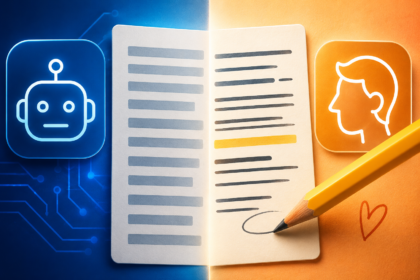
When folks debate AI vs human writers and content creators, they usually picture a winner-takes-all showdown. Robots on one side, struggling freelancers on the other.
That framing is wrong, and it leads people to make bad decisions.
The real question isn’t “which one wins.” It’s “what is each one genuinely good at, and how do you get the best result for your specific goal?” Once I reframed it that way, the noise cleared up fast.
AI is a tool. A very powerful one. But a tool still needs a hand to guide it, and that hand matters more than most people admit.
Where AI Writing Genuinely Shines
I’ll give credit where it’s due. Modern AI writing models are impressive, and pretending otherwise would be dishonest.
Here’s where AI consistently outperformed my own manual effort during testing.
Speed and Volume
This one isn’t close. AI produces first drafts faster than any human alive. If you need ten product descriptions, twenty meta descriptions, or a quick outline, AI delivers in seconds.
For repetitive, high-volume tasks, the time savings are enormous. I cut my drafting time by roughly 60% on routine pieces.
Beating the Blank Page
The hardest part of writing is often the first sentence. AI obliterates that problem. Even a mediocre AI draft gives me something to react to, edit, and improve.
Starting from “something” beats staring at “nothing” every single time.
Structure and Research Summaries
AI is excellent at organizing messy ideas into clean headings, summarizing long documents, and suggesting angles I hadn’t considered. It’s like brainstorming with a tireless assistant who never gets bored.
Cost Efficiency
For small businesses on tight budgets, AI lowers the barrier to producing content at all. That’s a real advantage, and it’s why adoption has exploded.
So if AI is this capable, why am I not worried about human writers disappearing? Because raw output is only half the job.
Where Human Writers Still Win Decisively
Here’s the part the hype crowd skips. After publishing dozens of pieces, the human-led content quietly outperformed the pure-AI content on the metrics that actually matter: time on page, return visitors, and reader trust.
These are the gaps AI hasn’t closed.
Real Experience and Original Insight
AI can describe what it’s like to use a budgeting app. It can’t actually have used one, gotten frustrated, found a workaround, and remembered that frustration two months later. I can.
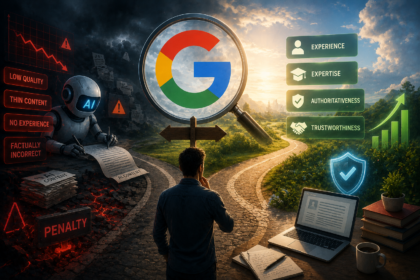
That lived experience is exactly what Google’s guidelines reward, and it’s something AI fundamentally cannot fake. For more on why this matters, Google has been clear that helpful, people-first content built on genuine expertise is what earns rankings.
Emotional Nuance and Voice
AI writing often reads smooth but soulless. It hits the right words without the right feeling. Humans understand context, humor, timing, and the unspoken stuff between the lines.
When a reader feels understood, they stick around. AI rarely creates that feeling on its own.
Fact-Checking and Accountability
AI confidently invents facts. It’s called hallucination, and it’s a serious risk. A human writer carries accountability. We verify, we correct, and we put our name on the work.
For anything involving health, finance, or advice readers will act on, that accountability isn’t optional.
Strategic Judgment
Knowing what to write, for whom, and why is a human skill. AI answers the question you ask. A skilled creator knows which question is worth asking in the first place.
A Quick Real-World Test I Ran
To stop guessing, I ran a simple experiment. I picked one topic and produced two versions: one written almost entirely by AI with light cleanup, and one where I used AI for the draft but rebuilt it with my own examples and voice.
I published both, gave them equal promotion, and waited a month.
The pure-AI version got clicks but bounced fast. Readers landed, skimmed, and left within seconds. It read fine, but it said nothing only I could say.
The human-refined version held attention nearly three times longer. People commented. A few emailed me. One reader said it felt like advice from a friend who’d actually been there.
That gap is the entire argument in miniature. AI got people to the page. The human element kept them there and earned their trust. For a content business, trust is the asset that compounds.
The Honest Verdict: It’s Not Either/Or
So can AI replace content creators? Based on everything I’ve tested, no, not the good ones.
But here’s the uncomfortable truth: AI will absolutely replace writers who refuse to use it. The future doesn’t belong to AI or to humans. It belongs to humans who use AI well.
The writers thriving right now treat AI like a power tool. They handle the strategy, the voice, the experience, and the final polish. AI handles the grunt work.
That partnership is faster than a human alone and far better than AI alone.
How to Combine AI and Human Writing (Step-by-Step)
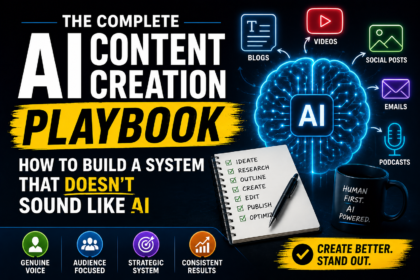
This is the workflow I use now for nearly every article. It keeps the speed of AI while protecting the quality and originality that keeps content AdSense-friendly and reader-friendly.
Follow these steps in order.
Step 1: Start with a human-led strategy. Before touching any AI tool, I decide the topic, the target reader, the angle, and the one key takeaway. This is the thinking AI can’t do for you. Skip it and you’ll get generic content that ranks for nothing.
Step 2: Use AI for the outline and rough draft. Now I let AI do what it’s great at. I give it my angle and ask for a structured outline, then a first draft. I treat this draft as raw clay, never the finished product.
Step 3: Rip it apart and rebuild with experience. This is the most important step. I rewrite weak sections in my own voice, add personal stories, delete fluff, and inject real examples AI couldn’t know. If a paragraph sounds like a robot wrote it, it goes. If you want help picking the right tool for this stage.
Step 4: Fact-check everything. I verify every statistic, name, date, and claim. AI lies confidently, so I trust nothing without checking. This single habit has saved me from publishing embarrassing errors more than once.
Step 5: Add the human signals. A strong intro hook, a clear takeaway, a personal opinion, a relatable analogy. These are the fingerprints that tell readers and search engines a real person made this.
Step 6: Read it aloud before publishing. If it sounds awkward when spoken, it reads awkward too. This final pass catches the stiff, AI-flavored sentences that slip through everything else.
Done right, this process gives you content that’s fast to produce yet genuinely human where it counts.
What This Means for AdSense and SEO
If you’re building a content site that depends on ad revenue or organic traffic, this matters enormously.
Search engines and ad networks are cracking down on low-effort, mass-produced AI spam. Sites stuffed with unedited AI content are getting deindexed and rejected.
But content that’s AI-assisted and human-refined? That’s perfectly fine, and it’s exactly what the major platforms encourage. The rule of thumb is simple: focus on helping the reader, not on how the content was made.
Original insight, accuracy, and genuine value are your protection. The tool you used to draft it is far less important than the effort you put into making it useful.
Common Myths About AI vs Human Writers
Let me clear up a few things I hear constantly, because the myths cause real damage.
Myth 1: AI content automatically gets penalized. False. Quality matters, not the tool. Helpful AI-assisted content ranks fine. Lazy content fails whether a human or a machine wrote it.
Myth 2: AI writes for free, so writers are doomed. The tools cost money, and the editing time is real. The “free” content still needs a skilled human to be worth publishing.
Myth 3: AI will get so good it won’t need humans. Maybe someday. But experience, accountability, and original judgment are hard problems. For now, and the foreseeable future, the human stays essential.
Frequently Asked Questions
Can AI completely replace human content creators? No. AI can replace certain repetitive writing tasks and speed up drafting, but it can’t replicate real experience, emotional nuance, accountability, or strategic judgment. The strongest results come from humans using AI as a tool, not from either working alone.
Is AI-generated content allowed by Google AdSense and Search? Yes, as long as it’s helpful, original, and high quality. The platforms care about value to the reader, not the production method. Unedited, mass-produced AI spam gets penalized; thoughtfully edited, human-refined content does not.
Will using AI hurt my SEO rankings? Not if you edit and add genuine value. Problems arise when sites publish thin, inaccurate, or duplicate AI content at scale. Human oversight, fact-checking, and original insight keep your content safe and competitive.
What kind of writing should I still do entirely by hand? Anything requiring personal experience, sensitive advice (health, finance, legal), strong emotional connection, or original research. These are the areas where human credibility and accountability matter most.
How do I make AI content sound less robotic? Rewrite in your own voice, add personal stories and examples, vary your sentence length, cut filler phrases, and read the piece aloud before publishing. The goal is to make it sound like a knowledgeable person, not a template.
Is it worth paying for AI writing tools? For most creators, yes. The time savings on drafting, outlining, and research summaries usually justify the cost, provided you still invest human effort in editing and strategy. The tool amplifies a skilled writer; it doesn’t replace one.
The Real Takeaway
The “AI vs human writers” framing was always a trap. It’s not a fight, it’s a partnership, and the creators who understand that are already pulling ahead.
AI gives you speed. You give it judgment, experience, and a soul. Treat the machine as your drafting engine and yourself as the editor-in-chief, and you’ll produce content that’s faster than a human alone and far better than AI alone.
So stop asking whether AI will replace you. Start asking how you’ll use it to outwork everyone who’s still arguing about it. Pick one article this week, run it through the six-step workflow above, and see the difference for yourself. That’s how you stay irreplaceable.