

People often ask me how I went from being a gifted kid with an IQ of 150 to building multiple profitable businesses around artificial intelligence.
The truth is, it wasn’t because I was smarter than everyone else. It was because I learned how to turn deep AI knowledge into something practical — something people were actually willing to pay for.
My name is Dhanur. I graduated from Stanford University with a degree in Computer Science and later earned a Master’s in Artificial Intelligence from MIT. Growing up, I was always “the smart kid” — the one who finished tests early and asked questions that made teachers pause. But it wasn’t until I stepped into the world of AI during my time at Stanford that I realized this technology wasn’t just fascinating. It was going to fundamentally change everything.
What I want to share with you today is not another list of trendy tools or get-rich-quick schemes. It’s the honest path I took: how I built a strong foundation in AI, where I learned what really matters, and most importantly, how I turned that knowledge into sustainable, profitable businesses that generate real income.
If you’re someone who wants to truly understand artificial intelligence — not just use it, but master it — and use it to create real value (and income), this article is for you.
My Early Years and the Gift That Came with Responsibility
From a young age, I was identified as gifted. At just 12 years old, I scored 150 on an IQ test. Teachers called me “gifted,” but my parents treated it as a responsibility. They made sure I never coasted on natural talent. I was taught early that intelligence without direction, discipline, and hard work is wasted potential.
When I got into Stanford, I was both excited and overwhelmed. For the first two years, I studied broadly — mathematics, psychology, philosophy, and cognitive science. But everything changed in my junior year when I took my first serious machine learning course. I still remember sitting in that lecture hall, the moment it hit me: AI wasn’t distant science fiction. It was something we could actually build, right now.
I threw myself completely into the field. Late nights in the lab, intense research projects, and deep conversations with professors who were actively shaping the future of the technology. By the time I graduated from Stanford and moved to MIT for my Master’s, I had already co-authored a small paper on neural networks and was completely hooked on the possibilities.
But here’s what many people don’t realize: having a high IQ and attending elite universities doesn’t automatically make you successful in business. The real turning point came when I learned how to apply AI in ways that solved painful, real-world problems for actual people — not just in research papers, but in practical, marketable ways.

The Real Path to Mastering AI – Where I Learned and Where You Can Too
After I graduated I took my time. I did not rush into starting a company. I spent years learning more about AI. I also tried out AI applications in the world. This period of learning and building helped me a lot. It became the foundation of everything I have achieved since with AI.
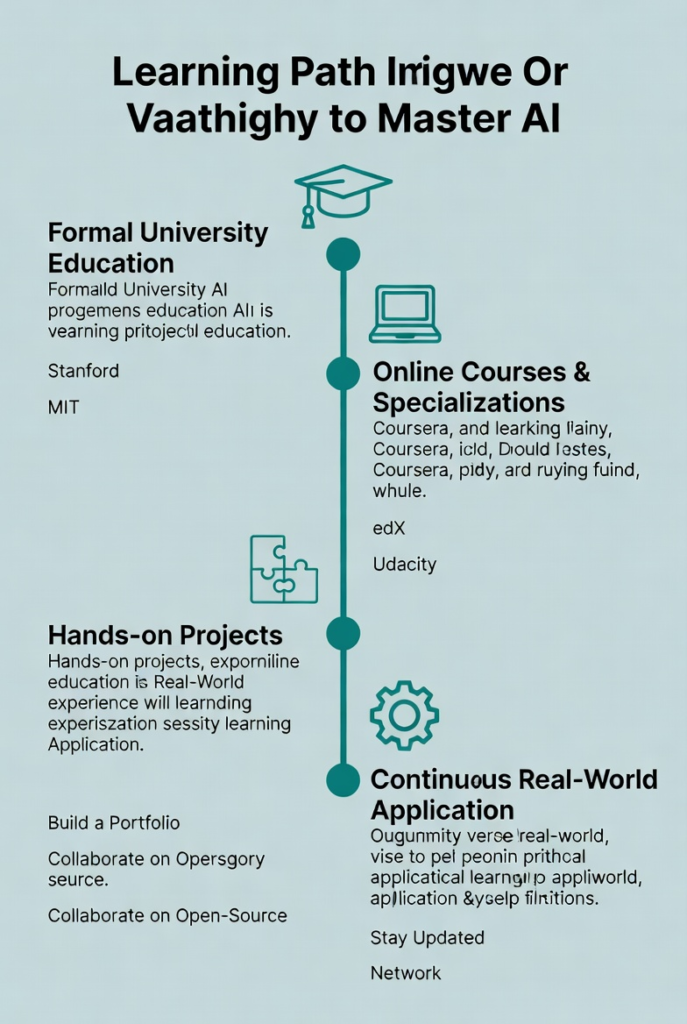
Here is what worked for me with AI. I think it can also help anyone who wants to master AI:
- Formal Education (The Strong Foundation)
I went to Stanford and MIT. They gave me a base in AI theory. Things like algorithms, neural networks and system design are important for AI. If you can get into an academic program it can help you learn AI faster. It is not the way to learn AI.
- Self-Directed Deep Learning
After my Master’s degree I studied AI on my own for months. I read AI research papers. I also took AI courses. Andrew Ng’s Deep Learning Specialization on Coursera was very helpful for learning AI. The key was not being talented in AI. It was being consistent and curious about AI.
- Hands-On AI Projects and Real-World Application
You cannot just learn AI theory. I built AI things: chatbots, AI writing tools, automation systems and predictive models. Each AI project taught me more, than any lecture or textbook. Failing at these AI projects was my teacher.
- Continuous Learning in the AI World
AI is changing fast. I made it a habit to stay updated on AI. I followed AI researchers. I tried out AI models soon as they came out. I also talked to people who used AI in business.
Here is what I learned about AI:
You do not need to go to Stanford or MIT to succeed in AI. Many good AI practitioners are self-taught. They learned through AI programs AI boot camps and personal AI projects.
The important thing is to go and learn AI. Do not just learn how to use ChatGPT or Midjourney. Try to understand how they work with AI. Know their AI limitations. Learn how to combine AI capabilities to solve real-world problems with AI.
That depth is what separates people who play with AI from those who build businesses with AI.
Turning AI Knowledge into a Real Business
I had to figure out how to make money from my AI knowledge. Many tech-savvy people struggle with this. They know the tech. Not how to turn it into cash.
I started small. I offered AI consulting to businesses that needed help with automation. I also built tools and sold access to them. Later I created courses and digital products teaching others how to use AI.
The businesses that worked best for me had three things in common:
- They solved a problem for a specific group of people.
- They used AI in a way that was easy for customers to understand and use.
- They created value, like subscriptions or repeated use.
Today my businesses include AI tools, for entrepreneurs consulting for companies using AI and online programs that teach people how to use AI practically.
The important lesson I learned is that technical knowledge is only half the story. The other half is understanding people, their problems and how to communicate with them.

My Advice If You Want to Follow This Path
If you are reading this and thinking “I want to do something here is what I would tell my younger self:
Start with a real desire to learn. Do not think about money first think about understanding the subject of Artificial Intelligence. Make things. Then break them to see how they work. Learn from the times you fail.
Find a part of Artificial Intelligence that you really like. Artificial Intelligence has areas like computer vision, natural language processing, automation or generative Artificial Intelligence. It is better to know a lot about one area of Artificial Intelligence than to know a little about areas.
Then look for problems that people are facing. Talk to people. Listen to what they have to say. The best businesses are the ones that solve problems that you understand well.
Finally learn how to explain things in a way. The successful people in the field of Artificial Intelligence are not always the ones who know the most about the subject they are the ones who can explain complicated ideas in simple and useful ways.
You do not need to be extremely smart or have degrees from universities like Stanford and MIT to be successful in the field of Artificial Intelligence. You need to be curious keep trying and be willing to use what you know to do something.
The field of Artificial Intelligence is still open to everyone. There has never been a time to learn a lot, about Artificial Intelligence and use it to make something meaningful.
Written by Dhanur