

When I first started working with AI to create content in 2025 I made just about every mistake you can think of. I thought the tools would do all the work for me so I published articles that felt of generic.. You know what happened? I got little response from readers.. After trying a lot of different things and making adjustments I figured out how to use AI to help me create content that actually helps people and gets better over time.
Today I want to share what has worked best for me on UseAIPulse.com. This is not a way to get rich quickly. It is a step-by-step process that focuses on creating content that is valuable while saving time.
Why AI Alone Is Not
AI tools like Claude, Grok, ChatGPT and Gemini are really good at helping with research, outlining and drafting.. Content that is created only with AI often lacks depth personal stories and authenticity. Google and readers can usually tell the difference between AI content and human content.
The key is to use AI as an assistant not as the person who writes the final article. In my experience the best results come when I spend 60-70% of the time editing adding my own examples and verifying information. I use AI for 30-40% of the time to help me with research and drafting.
Step 1: Choose a Clear Topic and Understand Your Audience
First I try to identify problems that my readers are facing. On my site I focus on helping people who work alone and small creators use AI to improve their workflow without feeling overwhelmed.
Of asking AI for a list of ideas I give it some context. For example I might say: “Generate 8 topic ideas for beginners who want to use AI for blogging but are worried about producing low-quality content. Include why each topic matters in 2026.” This gives me more targeted suggestions.
Step 2: Create a Strong Outline First
I always create an outline before I start writing a full draft. A good outline includes the question that the article answers, key sections, with sub-points my own experiences or examples and practical steps or checklists. Only after my outline feels solid do I ask the AI to expand sections. This helps prevent the article from becoming a block of text.
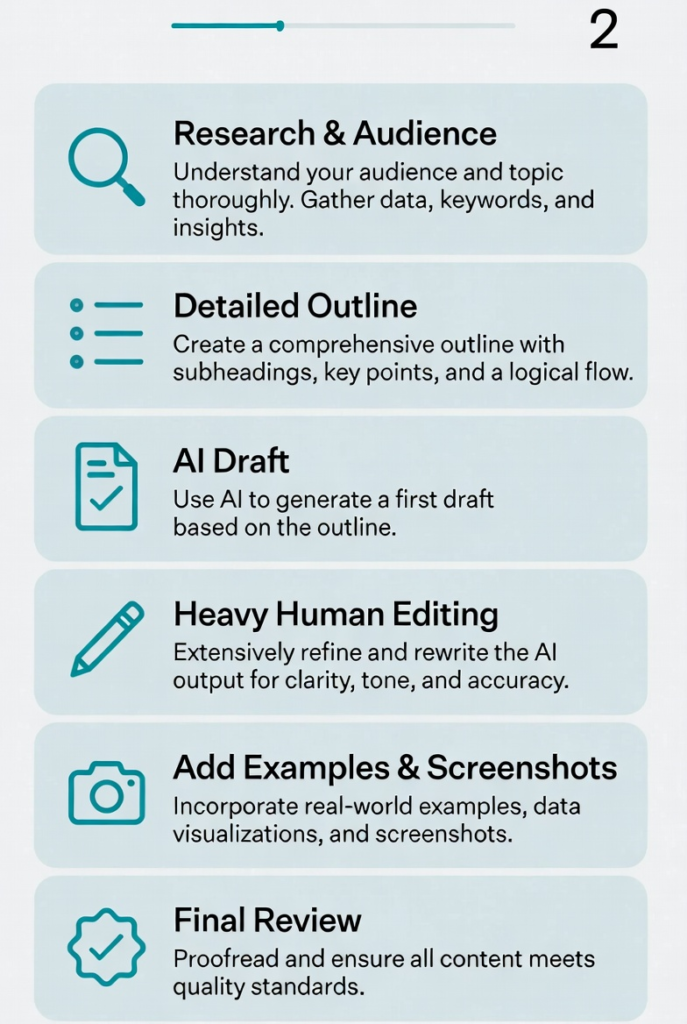
Step 3: Create Drafts with Clear Prompts
The quality of your output depends on the quality of your prompts. If your instructions are unclear you get results.. If you give detailed and well-structured prompts you get much better drafts.
Of a general prompt like “Write an article about AI for content ” I use something more specific:
“Write a 400-word section on creating effective prompts for AI writing tools. Use a tone thats easy to understand. Include 2-3 examples from everyday blogging tasks and one common mistake to avoid. Make it practical and useful.”
After I get the draft from Claude or Grok I never publish it as-‘s. I rewrite most of it in my voice add personal stories share my real results (and failures) and include screenshots from the actual tools I use.
Step 4: Add Value with Personal Experience
This step is what makes AI-assisted content truly valuable and high-quality. It also helps with EE-A-T (Experience, Expertise, Authoritativeness and Trustworthiness) signals that Google looks for.
In every article I make sure to include:
- tools I’ve personally tested with honest pros and cons and my real-world opinion
- One or two detailed examples from my workflow
- Lessons I’ve learned from my mistakes (like the time I published an article with zero editing and saw very high bounce rates)
- Practical checklists, templates or swipe files that readers can use away
Readers can tell when I’m being genuine. When I openly admit that certain AI-generated sections needed rewriting or share a strategy that didn’t work for me it builds trust and connection.
Step 5: Edit Fact-Check and Optimize for Readers
Once the draft feels solid I step into editor mode and ask myself these questions:
- Does this article completely answer the reader’s question?
- Is the language clear, conversational and easy to follow?
- Have I added original insight and personal experience?
- Are there actionable steps the reader can try today?
I also carefully fact-check all information, update tool names and features if newer versions have been released, fix any AI phrasing and improve flow. This final human refinement stage usually takes 30–45 minutes. Makes a big difference, in quality and reader satisfaction.

Mistakes to Avoid in 2026
After working with Artificial Intelligence for content creation for some time and observing many other creators I have noticed the same mistakes repeatedly holding people back. Here are the important Artificial Intelligence mistakes to avoid:
Publishing raw or only lightly edited Artificial Intelligence output. It often feels generic, soulless and gets poor engagement and low rankings.
Focusing much on keyword stuffing instead of genuinely solving real problems for readers of Artificial Intelligence content.
Creating many similar articles without bringing fresh insights or new angles to Artificial Intelligence content.
Leaving out any perspective real-world testing or honest opinions about Artificial Intelligence.
Taking the time to inject your own voice share personal stories and add unique value to Artificial Intelligence content almost always leads to better reader retention, stronger SEO performance and more loyal readers of Artificial Intelligence content in the long run.
Final Tips for Sustainable Content Creation
The goal is not to produce as Artificial Intelligence content as possible. It is to create Artificial Intelligence content that truly helps people and stands the test of time. Here are my best tips for long-term success with Artificial Intelligence:
Prioritize quality over quantity of Artificial Intelligence content. One researched, thoroughly edited article about Artificial Intelligence is almost always more valuable than three rushed mediocre ones about Artificial Intelligence.
Keep learning about Artificial Intelligence. Artificial Intelligence tools improve every month. Set aside time each week to experiment with features and models of Artificial Intelligence.
Be transparent with your audience about using Artificial Intelligence. Honestly mentioning that you use Artificial Intelligence as an assistant while doing the final editing and adding your own experience often builds more trust, not less in Artificial Intelligence.
Track what actually works with Artificial Intelligence. Regularly review which articles about Artificial Intelligence get the comments time on page, shares or conversions and apply those lessons to future Artificial Intelligence content.
Using Artificial Intelligence effectively does not mean replacing your thinking. It means amplifying it with Artificial Intelligence. When approached thoughtfully Artificial Intelligence becomes one of the tools available to help you create more helpful higher-quality Artificial Intelligence content while maintaining a healthy and sustainable workflow with Artificial Intelligence.
If you are just starting out with Artificial Intelligence do not try to do everything at once with Artificial Intelligence. Begin with one project: outline a single article about Artificial Intelligence using the steps above edit it thoroughly with your own voice and experience with Artificial Intelligence and publish it about Artificial Intelligence. Over time the entire process becomes more natural, faster. The quality of your work with Artificial Intelligence improves dramatically.
I would love to hear about your experience using Artificial Intelligence for content creation about Artificial Intelligence.
What has worked well for you with Artificial Intelligence? What challenges are you currently facing with Artificial Intelligence? Feel free to share in the comments I read every one and often reply with specific advice, about Artificial Intelligence.